
Furniture Hardware
1820–30
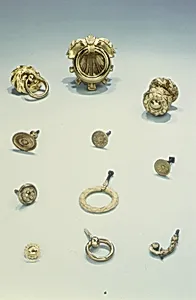
Medium
Gilt brass
Dimensions
Diam. 1 5/16 in. (3.3 cm)
Classification
Furniture hardware
Department
The American Wing
Museum
Metropolitan Museum of Art, New York, NY
Credit
Gift of Mrs. Edward Hunting Smith, 1968
Accession Number
Inst.68.8.40
Rights
Public Domain
Art Historical Context
This exquisite piece of furniture hardware, crafted by Henry Kellam Hancock between 1820 and 1830, exemplifies the refined decorative arts of early nineteenth-century America. Measuring just over an inch in diameter, this gilt brass fitting—likely a drawer pull or escutcheon—would have adorned elegant case furniture in prosperous households. The warm, golden sheen achieved through gilding on brass not only enhanced its visual appeal but also protected the metal from tarnish, making it both practical and luxurious. Hancock’s work reflects the growing sophistication of American metalworkers during the Federal and early Empire periods, when imported European styles blended with local craftsmanship. Such hardware transformed ordinary furniture into statements of taste and status, often featuring delicate neoclassical motifs suited to the era’s restrained elegance. Now part of the Metropolitan Museum’s American Wing thanks to a generous 1968 gift, this small object offers visitors a tangible connection to the material culture of the young republic. It reminds us that beauty in the decorative arts often resides in the details that daily life touches.
About the Artist
Henry Kellam Hancock · 1816–1851
Henry Kellam Hancock (1788–1854) was a prominent American cabinetmaker based in Boston, Massachusetts, where he contributed significantly to the city's early nineteenth-century furniture trade. Son of Captain Belcher Hancock and Ann "Nancy" Susan Ackers, he entered the profession as a chairmaker around 1816 and transitioned to cabinetmaking by 1826, maintaining workshops on Orange Street from abou...