
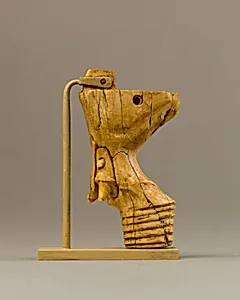
Furniture Leg
Unknown Artist
ca. 3100–2900 B.C.
Medium
Ivory (elephant)
Dimensions
H: 6 cm (2 3/8 in.)
Classification
Furniture Leg
Period
Early Dynastic Period
Department
Egyptian Art
Museum
Metropolitan Museum of Art, New York, NY
Credit
Purchase, Edward S. Harkness Gift, 1926
Accession Number
26.7.1283
Rights
Public Domain
Tags
Art Historical Context
This delicate furniture leg, carved from elephant ivory around 3100–2900 B.C., hails from Egypt's Early Dynastic Period Dynasty 1—the formative era when the Nile Valley's kingdoms unified under the first pharaoh, like Narmer. just 6 cm tall, it likely supported a stool or chair belonging to an elite figure, perhaps placed in a to serve in the afterlife. Such furnishings symbolized status and continuity between earthly life and eternity, reflecting the period's emerging monumental architecture and complex society. Crafted from prized elephant ivory, a luxury import from sub-Saharan Africa, the leg showcases the ancient Egyptians' masterful carving techniques. Ivory's smooth, durable surface allowed for precise shaping, highlighting the artisan's skill despite the unknown creator. This medium underscored wealth and access to long-distance trade networks, even in these nascent dynasties. Today, at the Metropolitan Museum of Art, this unassuming yet exquisite fragment offers a tactile glimpse into royal workshops, inviting us to ponder the opulence hidden within predynastic tombs.