
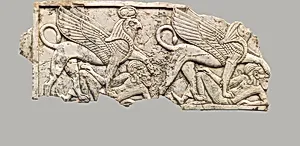
Furniture plaque carved in relief with two falcon-headed sphinxes trampling captives
Unknown Artist
ca. 9th–7th century BCE
Medium
Ivory
Dimensions
3 1/4 × 7 3/4 × 3 1/8 in. (8.2 × 19.7 × 8 cm)
Classification
Ivory/Bone-Reliefs
Culture & Period
Assyrian · Neo-Assyrian
Department
Ancient Near Eastern Art
Museum
Metropolitan Museum of Art, New York, NY
Credit
Rogers Fund, 1961
Accession Number
61.197.8
Rights
Public Domain
Tags
Art Historical Context
This exquisite ivory plaque, carved in low relief, hails from the Neo-Assyrian Empire (ca. 9th–7th century BCE), a period when Assyria dominated the ancient Near East through military might and cultural splendor. Measuring just 3¼ × 7¾ × 3⅛ inches, it once adorned elite furniture, such as thrones or tables in royal palaces. The scene depicts two falcon-headed sphinxes—powerful mythical guardians blending human, bird, and lion features—triumphantly trampling bound captives. These motifs symbolize Assyrian supremacy over enemies, a common theme in the empire's art that celebrated conquests from Egypt to Iran. Crafted from elephant ivory, likely imported via trade routes, the plaque showcases masterful Neo-Assyrian carving techniques. Artisans incised fine details into the hard material, capturing the sphinxes' dynamic poses, feathered wings, and fierce expressions with remarkable precision. Ivory's rarity and workability made it a luxury medium for propaganda art, reserved for the upper echelons of society. Today, housed in the Metropolitan Museum of Art's Ancient Near Eastern Art department (Rogers Fund, 1961), this relic offers a window into Assyrian worldview: divine protection ensuring imperial dominance. Visitors can almost hear the echoes of ancient victories in its intricate storytelling.