
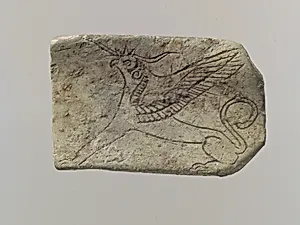
Furniture plaque: incised griffin
Unknown Artist
ca. 18th century BCE
Medium
Ivory
Dimensions
1.61 x 1.04 in. (4.09 x 2.64 cm)
Classification
Ivory/Bone-Reliefs
Culture & Period
Old Assyrian Trading Colony · Middle Bronze Age–Old Assyrian Trading Colony
Department
Ancient Near Eastern Art
Museum
Metropolitan Museum of Art, New York, NY
Credit
Gift of Mrs. George D. Pratt, in memory of George D. Pratt, 1936
Accession Number
36.152.7
Rights
Public Domain
Tags
Art Historical Context
This delicate ivory plaque, carved with an incised griffin,ails from the Old Assyrian Trading Colony in Anatolia (modern-day Turkey) around the 18th century BCE, the Middle Bronze Age. just 1.61 x 1.04 inches, it adorned furniture, showcasing the exquisite craftsmanship of ancient merchants who established bustling trade outposts like Kültepe. Ivory, a luxurious imported material, was highly prized for its workability and sheen, symbolizing wealth and status in these far-flung commercial hubs. The griffin—a mythical hybrid of lion and eagle—embodies power, vigilance, and divine protection, a motif common in Near Eastern art to ward off evil or assert dominance. The incising technique, where fine lines were meticulously engraved into the ivory surface, allowed for intricate detailing on such a tiny scale, highlighting the artist's skill in capturing the creature's fierce posture and stylized features. Discovered among artifacts from Assyrian trading networks that linked Mesopotamia with Anatolia, this plaque reveals how art flourished amid commerce, blending Mesopotamian influences with local styles. Today, gifted to the Metropolitan Museum of Art in 1936, it offers a window into the vibrant world of Bronze Age traders, where even everyday objects carried profound cultural weight.