
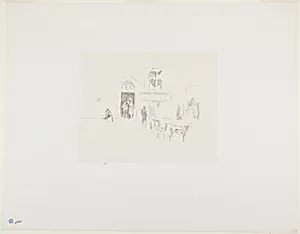
Gaiety Stage Door
1879, published 1887
Medium
Transfer lithograph in black with scraping, on cream chine, laid down on off-white plate paper
Dimensions
Image: 12.3 × 19.5 cm (4 7/8 × 7 11/16 in.); Primary support: 18.2 × 22.6 cm (7 3/16 × 8 15/16 in.); Secondary support: 37.4 × 47.8 cm (14 3/4 × 18 7/8 in.)
Classification
transfer lithograph
Department
Prints and Drawings
Museum
Art Institute of Chicago
Accession Number
139379
Rights
Public Domain
Art Historical Context
**Gaiety Stage Door James McNeill Whistler,1879 (published 1887)*Transfer lithograph, Art Institute of Chicago* Step through the lively world of Victorian London with James McNeill Whistler's *Gaiety Stage Door (1879, published 1887), a transfer lithograph that captures the threshold of the famed Gaiety Theatre. This music hall, a hub of burlesque revelry in London's theater district, symbolized the era's vibrant nightlife. Whistler, the American-born artist renowned for his Aesthetic movement ideals—"art for art's sake"—turned his keen eye to urban scenes, blending subtle tonal harmonies with Japanese-inspired simplicity. Crafted as a transfer lithograph in black ink with scraping techniques on cream Chine paper, the work showcases Whistler's innovative printmaking. He drew on transfer paper, then offset it onto a lithographic stone, allowing fluid, atmospheric effects akin to his famous nocturnes. The scraping adds textured depth, evoking misty shadows around the door—a portal to glamour amid everyday bustle. At just 12.3 × 19.5 cm, this intimate print from the Art Institute of Chicago's Prints and Drawings collection highlights Whistler's mastery in democratizing art through affordable multiples. It invites us to ponder the hidden lives behind the footlights, bridging high art and popular culture in late 19th-century Britain.
About the Artist
James McNeill Whistler · 1834–1903
James Abbott McNeill Whistler (1834-1903) was an American-born painter and printmaker who became a leading figure in the Aesthetic Movement and pioneer of Tonalism and Japonisme. He revolutionized art by championing "art for art's sake" and treating paintings as visual equivalents of musical compositions, titling works as "arrangements," "harmonies," and "nocturnes" to emphasize formal qualities o...