
Gambetta
c. 1876
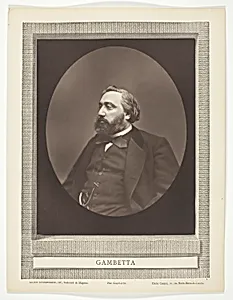
Medium
Woodburytype, from the periodical “Galerie Contemporaine Littéraire, Artistique” (1876), volume 1
Dimensions
Image: 20.4 × 16.9 cm (8 1/16 × 6 11/16 in.); Paper: 23.6 × 19.1 cm (9 5/16 × 7 9/16 in.); Mount: 34.2 × 26.2 cm (13 1/2 × 10 3/8 in.)
Classification
woodburytype
Department
Photography and Media
Museum
Art Institute of Chicago
Accession Number
144662
Rights
Public Domain
Art Historical Context
Étienne Carjat's *Gambetta* (c. 1876) captures the commanding presence of Léon Gambetta a fiery French statesman and key architect of the Third Republic. a celebrated photographer of Parisian intellectuals, writers, and politicians, Carjat immortalized Gambetta during a pivotal era following France's defeat in the Francoussian War. This woodburytype portrait, sourced from the inaugural volume of the prestigious periodical *Galerie Contempor Littéraire, Artistique reflects the growing fascination with photographic likenesses of cultural and political luminaries in late 19th-century Europe. The woodburytype process, pioneered in the 1870s, represents a pinnacle of Victorian-era photography. It involved pressing a gelatin relief into pigmented gelatin to create richly toned, permanent images with exceptional detail and subtle gradations—far superior to fading albumen prints. Measuring about 8 x 6 11/16 inches on its mount, this example showcases the medium's velvety depth, making Gambetta's stern gaze and textured attire leap vividly from the page. Housed in the Art Institute of Chicago's Photography and Media department, *Gambetta* highlights how photography bridged art and journalism, democratizing access to influential figures. It invites visitors to ponder Gambetta's oratory prowess and republican zeal, preserved through innovative 19th-century ingenuity.
About the Artist
Etienne Carjat · 1828–1906
Étienne Carjat (1828–1906) was a French photographer, caricaturist, and journalist who became one of the defining portraitists of nineteenth-century Parisian cultural life. Born in Fareins in the Ain department, he arrived in Paris as a young man and initially made his name as a caricaturist and writer, contributing to several satirical publications and cofounding the journal Le Boulevard in 1861....