
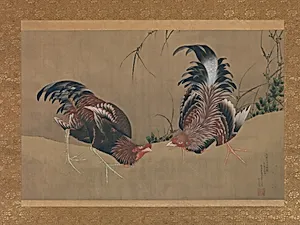
軍鶏図|Gamecocks
dated 1838
Medium
Hanging scroll; ink and color on silk
Dimensions
Image: 21 3/4 × 33 7/16 in. (55.3 × 85 cm) Overall with mounting: 59 7/16 × 40 3/16 in. (151 × 102 cm) Overall with knobs: 59 7/16 × 63 3/8 in. (151 × 160.9 cm)
Classification
Paintings
Culture & Period
Japan · Edo period (1615–1868)
Department
Asian Art
Museum
Metropolitan Museum of Art, New York, NY
Credit
Charles Stewart Smith Collection, Gift of Mrs. Charles Stewart Smith, Charles Stewart Smith Jr., and Howard Caswell Smith, in memory of Charles Stewart Smith, 1914
Accession Number
14.76.56
Rights
Public Domain
Tags
Art Historical Context
Katsushika Hokus's *Gamecocks* (軍鶏図), dated 1838, the fierce spirit of two roosters in a dynamic hanging scroll painted with ink and color on. Created late in the artist's prolific career—he was already famous for ukiyo-e woodblock prints like *The Great Wave off Kanagawa*— work showcases Hokusai's mastery traditional Japanese painting techniques. The medium of silk allowed for vibrant colors and fluid ink washes, emphasizing the birds' muscular forms, alert postures, and intense gazes, evoking the drama of cockfighting, a popular Edo-period pastime. Produced during Japan's Edo period (1615–1868), a time of relative peace and cultural flourishing, the scroll reflects Hokusai's fascination with nature and everyday life. Roosters symbolized vigilance, courage, and masculinity in Japanese culture, often depicted in art to convey power and rivalry. As a hanging scroll, it was designed for ceremonial display in homes or temples, unrolled to reveal its full 21¾ × 33⅞-inch image, inviting viewers to contemplate its energy up close. Now housed in the Metropolitan Museum of Art's Asian Art department, thanks to the Charles Stewart Smith Collection (gifted in 1914), *Gamecocks* exemplifies Hokusai's versatility beyond prints, blending precision with expressive vitality for enduring appeal.
About the Artist
Katsushika Hokusai · 1760–1849
Katsushika Hokusai (1760-1849) stands as one of history's most influential artists, a Japanese master who revolutionized the ukiyo-e woodblock print tradition and profoundly shaped Western art. Born in the Katsushika district of Edo (modern-day Tokyo) to an artisan family, Hokusai lived through nearly nine decades of extraordinary creative evolution, adopting over thirty different artistic names t...