
Medium
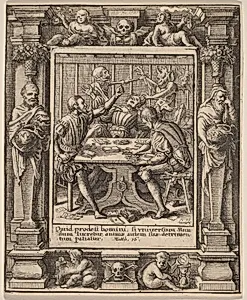
etching with border "Democritus and Heraclitus" (Pennington 233A)
Classification
Department
CG-E
Museum
National Gallery of Art, Washington, D.C.
Credit
Rosenwald Collection
Accession Number
1943.3.4901
Rights
Public Domain
Art Historical Context
"Gamesters," a captivating 1651 etching by the masterful Bohemian printmaker Wenceslaus Hol, draws from an illustrious lineage of artistic inspiration. Hollar meticulously reproduced a composition originally conceived by Renaissance portraitist Hans Holbein the Younger and elaborated by Flemish Baroque artist Abraham van Diepenbeeck. layered collaboration exemplifies the 17th-century practice of reproductive printmaking, where etchings democratized elite designs, making high art accessible beyond original paintings. The scene likely depicts gamblers immersed in a tense game, a popular moralizing motif warning against vice and folly—a theme amplified by the etched border featuring philosophers Democritus (the laughing sage) and Heraclitus (the weeping one). These ancient figures contrast mirth and melancholy, inviting viewers to reflect on human folly. Hollar's etching technique, with its fine lines and intricate shading (cataloged as Pennington 233A), showcases his virtuosity in capturing texture and expression, bridging Northern Renaissance precision with Baroque drama. Housed in the National Gallery of Art's Rosenwald Collection, this print highlights the era's cultural fascination with philosophy and everyday vices, offering timeless insight into 17th-century European society. A delightful window into art's reproductive magic!