
Garland (detail of fronton)
Unknown Artist
18th century
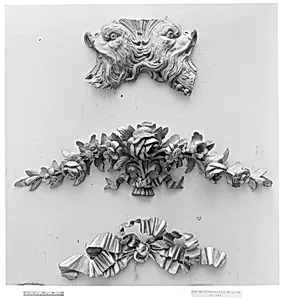
Medium
Wood, gilt
Dimensions
Overall: 27 1/2 × 8 1/2 in. (69.9 × 21.6 cm)
Classification
Woodwork
Culture
French
Department
European Sculpture and Decorative Arts
Museum
Metropolitan Museum of Art, New York, NY
Credit
Gift of J. Pierpont Morgan, 1906
Accession Number
07.225.344
Rights
Public Domain
Tags
Art Historical Context
This exquisite *Garland (detail of fronton)*, crafted in 18th-century France, exemplifies the opulent woodwork of the Rococo era. Carved from wood and adorned with gilt—a technique involving thin sheets of gold leaf applied over intricate carvings—this piece once embellished the triangular pediment, or fronton, above a doorway or window in a grand interior. Measuring 27½ × 8½ inches, its cascading motifs of flowers and leaves evoke abundance and natural beauty, hallmarks of French decorative arts that transformed homes of the aristocracy into lavish spectacles. In the lavish world of Louis XV's France, such garlands symbolized prosperity and the fleeting joys of life, drawing from classical antiquity while embracing playful asymmetry. The unknown artisan's mastery lies in the delicate relief carving, where petals and foliage seem to burst forth with lifelike vitality, enhanced by the shimmering gilt that catches the light. Gilding not only protected the wood but amplified its splendor, making spaces feel alive with golden warmth. A generous gift from financier J. Pierpont Morgan to The Metropolitan Museum of Art in 1906, this fragment preserves the elegance of pre-Revolutionary France. Visitors can appreciate how it once crowned architectural features in opulent hôtels particuliers, inviting us to envision the candlelit salons where it gleamed.