
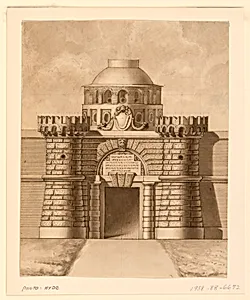
Gate with Papal Arms
Classification
architecture
Department
Smithsonian Collection
Museum
Smithsonian American Art Museum
Credit
Museum purchase through gift of various donors and from Eleanor G. Hewitt Fund
Accession Number
1938-88-6672
Rights
Public Domain
About this artwork
Research in Progress
Art Historical Context
**Gate with Papal Arms Leopold Pollack (1751–1806), a prominent Italian architect active during the late 18th century, created this striking architectural element classified simply as a gate adorned with papal arms. Though the exact date and medium remain unknown—reflecting ongoing research at the Smithsonian American Art Museum—this piece exemplifies Pollack's era of Italian design, where grand entrances often symbolized authority and faith. The inclusion of papal heraldry evokes the powerful influence of the Catholic Church in Italy, likely serving as an entrance to a religious or ecclesiastical site. As part of the Smithsonian Collection, acquired through museum purchase and generous donor gifts including the Eleanor G. Hewitt Fund, the gate highlights the intersection of architecture and symbolism. Papal arms, typically featuring keys and tiaras, underscored the Pope's spiritual and temporal power, making such motifs common in neoclassical and Baroque-inspired structures of the time. Pollack's work bridges artistic precision with historical grandeur, inviting visitors to ponder its original setting amid Italy's rich architectural heritage. While details continue to emerge through scholarly investigation, this gate stands as a tangible link to 18th-century Rome or Milan, where Pollack flourished, offering a window into the ornate world of ecclesiastical design. (198 words)