
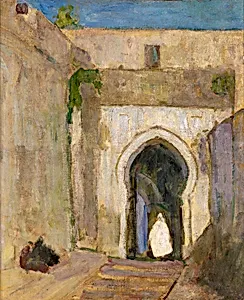
Gateway, Tangier
ca. 1910
Medium
Painting
Classification
Painting
Department
Smithsonian Collection
Museum
Smithsonian American Art Museum
Credit
Smithsonian American Art Museum, Gift of Mr. and Mrs. Norman Robbins
Accession Number
1983.95.190
Rights
Public Domain
Tags
About this artwork
After a trip to Algeria in 1908, Henry Ossawa Tanner traveled often from his Paris studio to the western coast of North Africa, where he visited Tangier, Morocco. He shared a fascination with painting the Orient with other French artists such as Eugène Delacroix, who said one must go to Tangier to experience the "rare influence of the sun, which gives penetrating light to all things." In this painting, Tanner captured the intensity of the Moroccan sun as well as Tangier's distinctive architectur...
Art Historical Context
Henry Ossawa Tanner, a African American artist based in Paris, was captivated by North Africa's luminous landscapes after a 1908 trip to Algeria. He made frequent journeys to Tangier, Morocco, joining a tradition of Western artists like Eugène Del, who praised the region's "penetrating light" from the sun. Created around 1910, *Gateway, Tangier* reflects Tanner's fascination with Orientalist themes, blending his realist style with impressions of exotic architecture and intense natural light. In this evocative painting, Tanner masterfully captures a sun-drenched gateway framed by textured walls, evoking Tangier's bustling roads and historic casbah. The composition highlights the play of light on sunbaked surfaces, creating depth and warmth that draws viewers into the scene. Whether painted en plein air or in his Paris studio, it showcases Tanner's skill in rendering atmospheric effects, a hallmark of his post-Impressionist influences. Possibly a study for his later work *Entrance to the Casbah* (c. 1912), *Gateway, Tangier* underscores Tanner's role in bridging American and European art traditions while documenting vanishing North African vignettes. Donated to the Smithsonian American Art Museum, it invites us to feel the "rare influence" of Moroccan sunlight.