
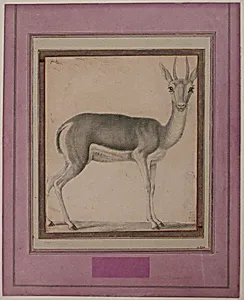
Gazelle
Unknown Artist
17th–18th century
Medium
Lead drawing
Dimensions
Image: H. 9 in. (22.9 cm) W. 7 7/8 in. (20 cm) Page: H. 14 in. (35.6 cm) W. 11 1/4 in. (28.6 cm) Mat: H. 19 1/4 in. (48.9 cm) W. 14 1/4 in. (36.2 cm)
Classification
Codices
Department
Islamic Art
Museum
Metropolitan Museum of Art, New York, NY
Credit
Gift of William Reinhold Valentiner, 1911
Accession Number
11.201
Rights
Public Domain
Tags
Art Historical Context
Nestled within the Metropolitan Museum of Art Islamic Art collection, *Gazelle* is a delicate lead drawing from the 17th–18th century created by an unknown artist. This artwork, classified as part of a codex—a bound manuscript typical of Islamic scholarly and artistic traditions—captures the graceful form of a gazelle on a page measuring 14 x 11¼ inches. The image itself spans about 9 x 7⅞ inches, rendered in the fine lines of leadpoint, a technique using a metal stylus to create precise, silvery marks on prepared surfaces. Donated in 1911 by William Reinhold Valentiner, it exemplifies the portability and intimacy of manuscript folios. In Islamic art, codices often served as vehicles for knowledge, blending science, poetry, and aesthetics. Gazelles, symbols of beauty and swiftness in Persian and Ottoman poetry, frequently appeared in such works, evoking the natural world's harmony. The use of lead drawing highlights a rare, tactile medium that allowed for subtle shading and detail, bridging technical precision with artistic elegance. Though the artist remains anonymous—a common trait in many Islamic manuscripts—this piece invites visitors to ponder the anonymous hands that preserved fleeting moments of the natural world amid grand cultural narratives.