
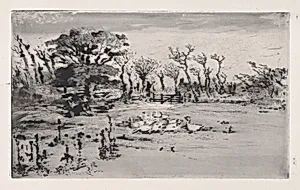
Geese
Medium
Etching, drypoint, and aquatint; first state of four
Dimensions
Plate: 6 x 10 1/16 in. (15.2 x 25.5 cm) Sheet: 8 7/8 x 13 3/16 in. (22.5 x 33.5 cm)
Classification
Prints
Department
Drawings and Prints
Museum
Metropolitan Museum of Art, New York, NY
Credit
Gift of David Keppel, 1921
Accession Number
21.16.16
Rights
Public Domain
Art Historical Context
Félix-Hilaire Buhot's *Geese* (1887) is a delightful etching, drypoint, and aquat from the first state of four, capturing the lively essence of its feathered subjects in intricate detail. Measuring a modest plate size of 6 x 10 1/16 inches, this print exemplifies Buhot's mastery of mixed intaglio techniques during France's late 19th etching revival. As a French printmaker (1841–1898), Buhot pushed the boundaries of printmaking, blending etching's precise lines, drypoint's velvety burr for texture, and aquatint's subtle tonal gradations to evoke a painterly richness akin to Impressionist effects. The first-state impression, gifted to the Metropolitan Museum of Art in 1921, offers a rare glimpse into Buhot's iterative process—early proofs like this reveal evolving layers of ink and wiping before final refinement. Buhot, influenced by James McNeill Whistler and Japanese ukiyo-e prints, infused his works with atmospheric depth and whimsy, often celebrating everyday rural motifs like these geese. This piece highlights printmaking's democratic appeal, making fine art accessible beyond paintings. In the Drawings and Prints department, *Geese* stands as a testament to technical innovation, inviting visitors to appreciate how Buhot transformed metal plates into textured, lifelike scenes that still charm today.
About the Artist
Félix-Hilaire Buhot · 1847–1898
Félix-Hilaire Buhot was born on July 9, 1847, in Valognes, a small town in Normandy, France, into a modest family—his father a wine merchant and his mother a seller of women's clothes. Orphaned by age seven after losing both parents and his maternal grandmother, he was raised by relatives, including a godfather, and received an early introduction to drawing from his adopted mother's nephew. In 186...