
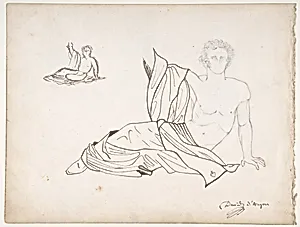
General Bonchamp Shown in a Pose Designed for His Tomb (Recto)
19th century
Medium
Graphite, pen and bown ink (recto); graphite (verso)
Dimensions
8 7/16 x 11 in. (21.4 x 28 cm)
Classification
Drawings
Department
Drawings and Prints
Museum
Metropolitan Museum of Art, New York, NY
Credit
Purchase, Karen B. Cohen Gift, 1989
Accession Number
1989.286.1
Rights
Public Domain
Tags
Art Historical Context
Pierre-Jean David d'Angers, a leading French Romantic sculptor of the 19th century, created this poignant preparatory drawing around the early 1800s. Titled *General Bonchamp Shown in Pose Designed for His TombRecto)*, it captures Charles de Bonchamps, a heroic Royalist general who fought in the counter-revolutionary Vendée Wars the French Revolution. Bonchamps became a symbol of chivalry after reportedly pardoning hundreds of captured Republican soldiers with his dying breath in 1793, an act that inspired Romantic ideals of nobility and sacrifice. The drawing's recto features fluid graphite lines combined with precise pen and brown ink to model Bonchamps in a dignified, reclining pose suited for a funerary monument—likely envisioning a sculptural tomb that never fully materialized. This double-sided sheet (verso in graphite alone) exemplifies David d'Angers's meticulous preparatory process, blending sketch-like freedom with sculptural anatomy. As a master of portrait medallions and public monuments, he often used such studies to infuse historical figures with emotional depth, bridging neoclassicism and Romanticism. Housed in the Metropolitan Museum of Art's Drawings and Prints department, this 8 7/16 x 11-inch work invites us to reflect on how art immortalizes wartime valor, turning personal tragedy into enduring cultural memory.
About the Artist
Pierre Jean David d'Angers · 1788–1856
Pierre-Jean David d'Angers, born on March 12, 1788, in Angers, France, to a wood carver and ornamental sculptor father who had fought in the Republican army, began his artistic training locally under Marchand and Jean-Jacques Delusse at the École centrale d'Angers from 1806 to 1807. In 1808, he arrived in Paris with scant funds and entered the studio of Philippe-Laurent Roland, later working under...