
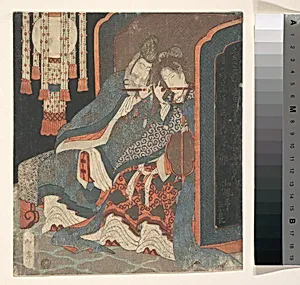
Genso and Yokihi
ca. 1820
Medium
Woodblock print (surimono); ink and color on paper
Dimensions
8 3/16 x 7 3/8 in. (20.8 x 18.7 cm)
Classification
Prints
Culture & Period
Japan · Edo period (1615–1868)
Department
Asian Art
Museum
Metropolitan Museum of Art, New York, NY
Credit
Rogers Fund, 1919
Accession Number
JP1131
Rights
Public Domain
Tags
Art Historical Context
In the enchanting woodblock print *Genso and Yokihi (ca. 1820), Yashima Gaki captures a tender moment between the legendary Chinese emperor Genso (Xuanzong of Tang) and his beloved consort Yokihi (Yang Guifei), by flutes that evoke their poetic romance. Created during Japan's Edo period (16151868), this intimate scene reflects the era's fascination with historical tales of love and music, blending Japanese ukiyo-e aesthetics with Chinese lore popular in kabuki theater and literature. Gakutei, a master of surimono—luxurious, privately commissioned prints often made for poetry gatherings or New Year's greetings—employed exquisite techniques like fine line work, vibrant colors, and subtle gradations of ink on paper. Measuring just 8 3/16 x 7 3/8 inches, its small scale belies its technical sophistication, showcasing the woodblock process's precision in rendering delicate fabrics, expressive faces, and musical instruments. Surimono like this were elite art forms, prized for their poetic inscriptions (though not visible here) and metallic accents. Housed in the Metropolitan Museum of Art's Asian Art Department since 1919 via the Rogers Fund, this print highlights Edo Japan's vibrant print culture, bridging everyday beauty with timeless stories of passion. Visitors will appreciate its cultural fusion and the flutes' symbolic harmony.
About the Artist
Yashima Gakutei · 1786–1868
Yashima Gakutei (c. 1786–1868), born in Osaka as the illegitimate son of a Tokugawa shogunate samurai named Hirata, adopted the name from his mother's subsequent marriage into the Yashima clan. Little is documented about his early years beyond these familial ties, but he pursued artistic training under the esteemed ukiyo-e masters Totoya Hokkei and Katsushika Hokusai, absorbing their precision in ...