
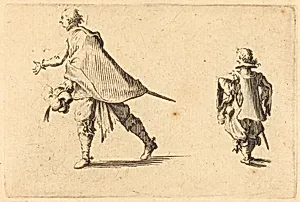
Gentleman and His Page
c. 1622
Medium
etching on laid paper
Dimensions
plate: 5.7 × 8.5 cm (2 1/4 × 3 3/8 in.) sheet: 9.3 × 12.6 cm (3 11/16 × 4 15/16 in.)
Classification
Department
CG-E
Museum
National Gallery of Art, Washington, D.C.
Credit
Rosenwald Collection
Accession Number
1949.5.150
Rights
Public Domain
Art Historical Context
**Gentleman and His Page** a delicate etching by the renowned French printmaker Jacques Callot, created around 1622. Measuring just 5.7 × 8.5 cm on the plate, this intimate work captures a finely dressed gentleman accompanied by his young page, rendered with Callot's signature precision on laid paper. Housed in the National Gallery of Art's Rosenwald Collection (Department CG-E), it exemplifies the artist's mastery of small-scale prints, which were highly prized by 17th-century collectors for their portability and detail. Callot, a pivotal figure in the transition from Mannerism to Baroque art, revolutionized etching techniques during his time in Italy and Lorraine. His innovative use of a hard-ground etching process allowed for extraordinarily fine lines and intricate textures, bringing everyday scenes to life with remarkable clarity. This piece likely reflects the social hierarchies of early 17th-century Europe, showcasing the elegance of noble attire and the dynamics between master and servant amid the opulent courts of the period. Etchings like this one were revolutionary for their reproducibility, making high art accessible beyond paintings. Callot's works influenced generations of printmakers, blending technical virtuosity with keen observation of human character—perfect for savoring up close in a quiet gallery corner.
About the Artist
Jacques Callot · 1592–1635
Jacques Callot (1592–1635) was a French printmaker and draftsman from the Duchy of Lorraine, widely regarded as one of the first great artists to practice the graphic arts exclusively. His more than 1,400 etchings chronicled the breadth of 17th-century life, from Medici court festivities to the brutal realities of warfare. Callot revolutionized etching through technical innovations including the é...