
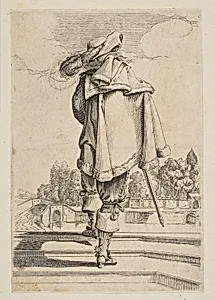
Gentleman in a Cape and Plumed Hat Seen from the Back
Medium
Etching (reverse copy)
Dimensions
Sheet (trimmed): 5 1/2 × 3 11/16 in. (13.9 × 9.4 cm)
Classification
Prints
Department
Drawings and Prints
Museum
Metropolitan Museum of Art, New York, NY
Credit
Harris Brisbane Dick Fund, 1953
Accession Number
53.600.1568
Rights
Public Domain
Tags
Art Historical Context
This charming etching, titled *Gentleman in a Cape Plumed Hat Seen from Back*, dates to 1629 and is attributed to French printmaker Abraham Bosse, with possible to Jean de Saint-Ig or an anonymous 17th-century artist. as a reverse copy—a mirrored reproduction likely used for transfer or study—it captures the elegance of early Baroque French fashion. The small, trimmed sheet (5 1/2 × 3 11/16 in.) showcases a stylish gentleman viewed from behind, his flowing cape and elaborate plumed hat evoking the opulent attire of Louis XIII's court, where such accessories signaled wealth and status. Etching, Bosse's specialty, allowed for intricate lines and textures that mimic drawing, making prints accessible for sharing fashion trends and social customs. Bosse, a master of the technique, often depicted everyday scenes with remarkable detail, influencing reproductive printmaking across Europe. This "reverse" version highlights the era's innovative print practices, where images were flipped for practical use in workshops or engraving. Housed in the Metropolitan Museum of Art's Drawings and Prints department (Harris Brisbane Dick Fund, 1953), the work offers a glimpse into 17th-century masculinity and sartorial flair, reminding us how art preserved fleeting styles for posterity. A delightful study in silhouette and swagger!
About the Artist
Jean de Saint-Igny|Anonymous, French, 17th century|Abraham Bosse · 1602–1676
Born 1595 or 1600, died after 1649. Comment on works: Sculptor; Painter; Draftsman; Designer