
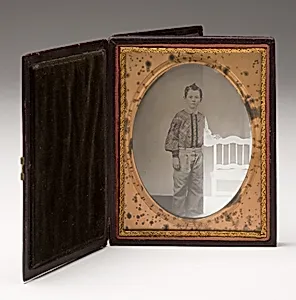
George E. Lane, Jr.
c. 1855
Medium
ambrotype with applied color
Dimensions
image (visible): 8.9 × 6.8 cm (3 1/2 × 2 11/16 in.) mat: 10.7 × 8.4 cm (4 3/16 × 3 5/16 in.) case (closed): 11.8 × 9.5 × 2 cm (4 5/8 × 3 3/4 × 13/16 in.)
Classification
Photograph
Department
CPH
Museum
National Gallery of Art, Washington, D.C.
Credit
Gift of Kathleen, Melissa and Pamela Stegeman
Accession Number
2008.133.3
Rights
Public Domain
Art Historical Context
Step into the intimate world of 19th American portraiture with *George E. Lane,.*, an ambrotype created around 1855. This small, gem-like photograph captures the solemn gaze of its young subject, likely a boy or young man, framed in a protective case that measures just 11.8 × 9.5 × 2 cm when closed. Produced by an anonymous American photographer, it exemplifies the democratizing power of early photography, which made professional portraits accessible to middle-class families during a time of rapid technological and social change in the United States. Ambrotypes, invented in the mid-1850s, were unique glass positives that appeared lifelike when backed with black paint or velvet—creating a one-of-a-kind image without the need for printing multiples, unlike daguerreotypes. Here, delicate applied color enhances the realism, tinting cheeks, lips, and clothing to evoke the warmth of painted miniatures. This hand-coloring technique was a popular flourish, bridging photography's novelty with traditional portrait artistry. Housed in the National Gallery of Art's photography collection as a gift from the Stegeman family, this artifact whispers of personal devotion—perhaps a memento for loved ones amid the uncertainties of antebellum America. Its compact size (visible image just 8.9 × 6.8 cm) made it perfect for a pocket or locket, preserving a fleeting moment in enduring glass.
About the Artist
American 19th Century · 1800–1900
The artist cataloged as "American, 19th Century" represents a collective of unidentified painters active in the United States during the nineteenth century, with 380 known artworks preserved in this virtual museum's collection. These works span a diverse array of genres typical of the era, including portraits, landscapes, still lifes, and genre scenes, reflecting the burgeoning artistic output of ...