
George Mills
1792
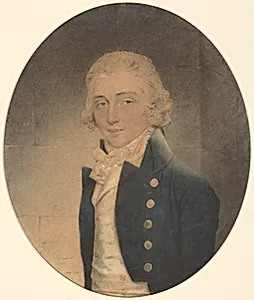
Medium
pastel with gray and brown wash on two overlapped sheets of laid paper joined at the top
Dimensions
image (oval): 22 x 18.9 cm (8 11/16 x 7 7/16 in.) sheet: 24 x 19.8 cm (9 7/16 x 7 13/16 in.)
Classification
Drawing
Department
CG-E
Museum
National Gallery of Art, Washington, D.C.
Credit
Ailsa Mellon Bruce Collection
Accession Number
1970.17.145
Rights
Public Domain
Art Historical Context
Created in 1792, John Downman’s portrait of George Mills exemplifies the refined elegance of late eighteenth-century British portraiture. Downman, a noted English artist celebrated for his delicate pastel works, captured his sitters with a soft, intimate touch that appealed to the era’s growing middle and upper classes. The oval format, a popular choice for personal keepsakes, suggests this drawing may have been intended for private display, perhaps in a family home or as a cherished memento. The medium—pastel combined with gray and brown wash on two overlapped sheets of laid paper—highlights Downman’s technical ingenuity. By joining the sheets at the top, he achieved a larger, stable surface while maintaining the luminous, velvety texture that pastel is prized for. The subtle washes add depth and modeling, enhancing the lifelike quality of the sitter’s features without the formality of oil painting. Housed in the National Gallery of Art’s Ailsa Mellon Bruce Collection, this work offers visitors a glimpse into Georgian-era portrait traditions, where drawings served as both affordable alternatives to paintings and highly personal expressions of identity.
About the Artist
John Downman · 1750–1824
John Downman (1750–1824) was born in Ruabon, near Wrexham, in North Wales. His artistic inclinations proved stronger than any legal ambitions his family held for him, and he began his formal training in Liverpool before enrolling in 1769 among the first intake of students at the newly established Royal Academy Schools in London. There he studied under Benjamin West. In 1773, Downman deepened his e...