
George Moon
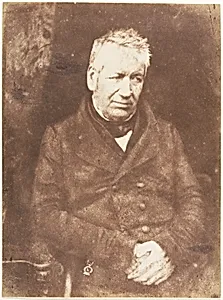
Medium
Salted paper print from paper negative
Classification
Photographs
Department
Photographs
Museum
Metropolitan Museum of Art, New York, NY
Credit
David Hunter McAlpin Fund, 1946
Accession Number
46.1.172
Rights
Public Domain
Tags
Art Historical Context
**George Moon**, a captivating salted paper print from a paper negative, captures the dignified likeness of its subject around 1843–47. Created by the pioneering Scottish partnership of David Octavius and Robert Adamson—often credited jointly as Hill and Adamson portrait exemplifies early photography's artistic potential. Hill, a noted painter, teamed up with chemist-photographer Adamson to document prominent figures, using the calotype process invented by William Henry Fox Talbot This technique involved a paper negative that produced soft, textured positives, lending a painterly quality reminiscent of Renaissance drawings. The image belongs to their renowned series of over 2,500 calotypes, many made to aid Hill's monumental painting *The Signing of the Deed of Demission* (1843), commemorating the Disruption of the Church of Scotland. As one of the first viable negative-positive processes, the salted paper print allowed for subtle tonal gradations and atmospheric depth, revolutionizing portraiture by blending photography's precision with artistic interpretation. George Moon, posed with quiet intensity, embodies the era's emerging photographic portrait tradition—intimate, character-driven studies that elevated the medium from novelty to fine art. Housed in The Metropolitan Museum of Art's Photographs Department (acquired via the David Hunter McAlpin Fund in 1946), this work invites visitors to appreciate how Hill and Adamson's innovations bridged painting and photography, forever shaping visual storytelling.
About the Artist
David Octavius Hill|Robert Adamson|Hill and Adamson · 1802–1870
David Octavius Hill (1802–1870) was a Scottish painter, photographer, and arts administrator whose pioneering photography partnership with Robert Adamson from 1843 to 1847 transformed the medium into an art form. Born in Perth and trained in Edinburgh, Hill established himself as a landscape painter and became secretary of the Royal Scottish Academy, a position he held for nearly forty years. His ...