
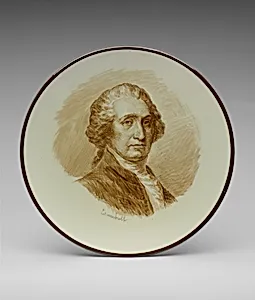
George Washington
Medium
Faience
Dimensions
Diam. 8 3/4 in. (22.2 cm)
Classification
Plaque
Culture
French
Department
The American Wing
Museum
Metropolitan Museum of Art, New York, NY
Credit
Gift of William H. Huntington, 1883
Accession Number
83.2.135
Rights
Public Domain
Tags
Art Historical Context
This faience portrait of George Washington, created between 1840 and 1883, captures the first U.S. president in a durable ceramic medium popular in 19th-century France. Measuring just under nine inches across, the circular piece likely draws from John Trumbull’s well-known painted likenesses of Washington, which circulated widely as symbols of American leadership and revolutionary ideals. Emile Dupont-Zipcy, working in the French faience tradition, translated that image into glazed earthenware, a technique prized for its bright, lasting colors and ability to produce affordable commemorative objects. Faience’s tin-glazed surface allowed artists to render fine details while protecting the decoration, making such portraits both decorative and enduring. Produced decades after Washington’s death, the work reflects the continued European fascination with America’s founding figures, especially in France, where Washington’s alliance with Lafayette remained a point of national pride. Now in the Metropolitan Museum’s American Wing, the object bridges French craftsmanship and American history, illustrating how 19th-century artisans helped keep Washington’s image alive across the Atlantic.