
Georges de Scudéry
ca. 1654
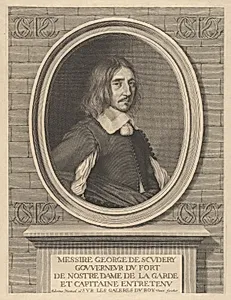
Medium
Engraving; first state of four (Petitjean & Wickert)
Dimensions
Sheet: 12 1/8 × 9 3/16 in. (30.8 × 23.4 cm) Plate: 10 3/8 × 7 5/8 in. (26.3 × 19.4 cm)
Classification
Prints
Department
Drawings and Prints
Museum
Metropolitan Museum of Art, New York, NY
Credit
Rogers Fund, 1920
Accession Number
20.13.13
Rights
Public Domain
Tags
About this artwork
This prints titled "Georges de Scudéry" by Robert Nanteuil dates to ca. 1654. Executed in engraving; first state of four (petitjean & wickert), this work exemplifies the craftsmanship associated with Drawings and Prints. The piece demonstrates the technical skill and artistic vision characteristic of its period. The work's presence in a major museum collection attests to its significance in the broader narrative of art history. As part of institutional holdings, it serves both scholarly research...
Art Historical Context
This exquisite engraving, *Georges de Scudéry* by Robert Nanteuilca. 1654), captures the likeness of a prominent French writer and intellectual from the mid-17th century. de Scudéry, of the celebrated novelist Madeleine de Scudéry was known for his contributions to literature drama during France's Golden Age under Louis XIV. Nante, one of the era's master engravers, produced this portrait in the first state of four rare early impression before later refinements—highlighting its value to collectors and scholars. Crafted with meticulous line work on a plate measuring 10 3/8 × 7 5/8 inches, the print exemplifies the technical precision of 17th-century French engraving. Nanteuil's portraits were renowned for their lifelike detail, subtle modeling of faces, and elegant rendering of costume and posture, making them essential for disseminating images of the cultural elite. As a print from the Drawings and Prints department at The Metropolitan Museum of Art (acquired via the Rogers Fund in 1920), it reflects the period's fascination with portraiture as both art and social document. This work offers a window into Baroque-era France, where prints bridged the gap between elite patronage and wider audiences, preserving the visages of thinkers like Scudéry amid the intellectual salons of Paris. A testament to enduring craftsmanship, it invites visitors to appreciate the artistry in every precise burr and line.
About the Artist
Robert Nanteuil · 1623–1678
Robert Nanteuil (1623-1678) was a French portrait engraver, draughtsman, and pastellist who became the preeminent portraitist to the court of Louis XIV. His technical mastery and royal patronage fundamentally transformed the status of engraving in France, elevating it from a mechanical craft to a recognized fine art. Nanteuil stands as the outstanding French portrait engraver of the seventeenth c...