
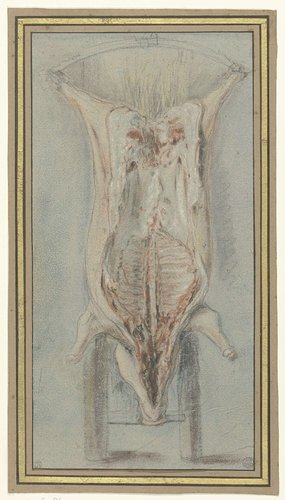
Geslacht varken op een leer
c. 1710 - 1757
Medium
paper
Dimensions
162; 314
Rights
Public Domain
About this artwork
annotatie, verso, middenonder, potlood: ‘Verz. Gigoux / Vente 1882 frs 120 / Chardin’
Art Historical Context
Jean-Baptiste-Siméon Chardin (1699–1779), a master of French still-life painting during the Rococo era, crafted this intimate drawing titled *Geslacht varken op een leer*—likely depicting a butchered pig carcass suspended on a leather strap. roughly between 1710 and 1757, the work measures a modest 314 × 162 mm on paper, showcasing Chardin's skill in capturing everyday realism. Unlike the ornate grandeur of his contemporaries, Chardin's subjects drew from humble domestic life, elevating ordinary objects like raw meat into studies of texture, light, and form through meticulous pencil or charcoal techniques. This drawing exemplifies Chardin's innovative approach to still life, influenced by 17th-century Dutch masters yet distinctly his own in its soft modeling and atmospheric depth. Rendered on paper, it may have served as a preparatory study for larger oil paintings, highlighting his draftsman's precision in rendering glistening surfaces and anatomical detail. Such motifs of slaughtered animals symbolized both abundance and mortality, resonating in 18th-century France amid growing interest in naturalistic observation. A pencil annotation on the verso adds intrigue: "Verz. Gigoux / Vente 1882 frs 120 / Chardin," noting its provenance from the Gigoux collection and sale for 120 francs in 1882. This humble work invites visitors to appreciate Chardin's genius in transforming the mundane into the monumental.