
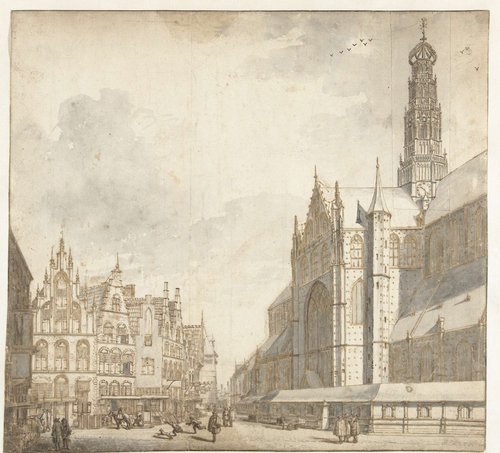
Gezicht op de Sint-Bavo te Haarlem
1668 - 1729
Medium
pen
Dimensions
375; 343
Rights
Public Domain
About this artwork
…;sale, Henri Duval (Liège, …-…), Amsterdam (Frederik Muller), 22 (23) June 1910 sqq., no. 438, as I.S. van der Vinne, fl. 600, to the dealer Artaria, Vienna;{Copy RMA.}…; …; collection Prince Franz Josef II von und zu Liechtenstein (1906-89), Vaduz;{Feilchenfeldt 2015, p. 137; note RMA.} from whom, fl. 750 , through the mediation of the dealer Walter Feilchenfeldt, Zürich, to the museum, 1948
Art Historical Context
**Gezicht op de-Bavo te Haarlem *Laurens Vincentsz. der Vinne (1668–1729), pen, 343 × 375 mm, 1668–1729* ens Vincentsz. der Vinne, a Dutch artist from a prominent family of painters and engravers in Haarlem, captures the majestic Sint-Bavo Church (also known as the Grote Kerk) in this detailed pen drawing. Completed sometime between 1668 and1729, the work offers a precise "gezicht" or view of this Gothic landmark, a symbol of Haarlem's prosperity during the Dutch Golden Age. The church, with its towering spire and intricate facade, was a favorite subject for local artists, reflecting the era's fascination with urban topography and architectural grandeur. Rendered in pen—likely ink on paper—this medium highlights van der Vinne's mastery of line work, allowing for sharp contrasts and fine details that evoke the church's scale and texture. Such drawings were valued for their documentary quality, serving as studies for prints or paintings, and exemplify the meticulous draftsmanship of 17th- and early 18th-century Dutch art. With a rich provenance, the piece passed through sales in Amsterdam (1910, once misattributed to I.S. van der Vinne) and the collection of Prince Franz Josef II of Liechtenstein before entering the museum in 1948. It invites visitors to appreciate Haarlem's enduring architectural legacy through a family artist's discerning eye.