
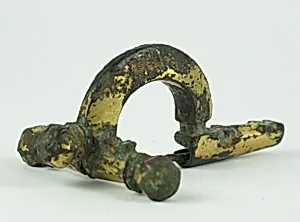
Gilt bronze crossbow fibula
Unknown Artist
4th century CE
Medium
Bronze, Gold
Dimensions
Other: 3 9/16 in. (9 cm)
Classification
Bronzes
Culture & Period
Roman · Late Imperial
Department
Greek and Roman Art
Museum
Metropolitan Museum of Art, New York, NY
Credit
Bequest of Mary Anna Palmer Draper, 1915
Accession Number
15.43.270
Rights
Public Domain
Art Historical Context
This exquisite gilt bronze crossbow fibula, dating to the 4th century CE, the craftsmanship of Late Imperial Rome. Measuring just 3 9/16 inches (9 cm), this small yet striking brooch—used to fasten cloaks or tunics—was both functional and a symbol of status. Its "crossbow" design refers to the arched bow-shaped spring mechanism, a innovative form that became widespread in the Roman provinces during this era of military expansion and cultural blending. Crafted from bronze and adorned with gilding—a technique where a thin layer of gold was applied via mercury amalgamation and heat—this fibula showcases advanced metalworking skills. The gold accentuates its intricate details, highlighting the wearer's wealth amid the economic shifts of the late Roman Empire. Such fibulae were especially favored by soldiers and officials, serving as badges of rank. Housed in the Metropolitan Museum of Art's Greek and Roman Art Department (Bequest of Mary Anna Palmer Draper, 1915), this piece offers a glimpse into daily life and hierarchy in a transforming empire, where practical accessories doubled as personal statements of power and prestige.