
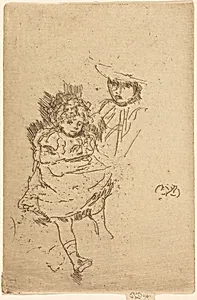
Gipsy Baby
1826 to 1850
Medium
etching on laid paper
Dimensions
overall (trimmed to plate): 9.9 × 6.5 cm (3 7/8 × 2 9/16 in.)
Classification
Department
CG-W
Museum
National Gallery of Art, Washington, D.C.
Credit
Rosenwald Collection
Accession Number
1943.3.8618
Rights
Public Domain
Art Historical Context
James McNeill Whistler’s *Gipsy Baby* is a delicate etching on laid paper, capturing the tender innocence of a young Romani child in a remarkably intimate scale—measuring just 9.9 × 6.5 cm. Created during Whistler’s early career, this print dates to between 1826 and 1850, likely reflecting the period of the antique laid paper used, which adds to its historical charm. Housed in the National Gallery of Art’s Rosenwald Collection, it exemplifies Whistler’s mastery of printmaking, a medium he elevated through precise, atmospheric lines that evoke subtle emotion without overt detail. Whistler, an American-born artist who championed the Aesthetic movement, revolutionized etching in the mid-19th century by treating it as fine art rather than mere reproduction. His technique here—soft, flowing strokes on trimmed plate edges—creates a dreamlike quality, blending Realism’s keen observation with a poetic haze. This work likely draws from Whistler’s fascination with everyday subjects during his Parisian and London years, offering a glimpse into 19th-century street life and cultural margins. For visitors, *Gipsy Baby* invites quiet contemplation of childhood’s universality, a testament to Whistler’s belief that art should evoke beauty and harmony above narrative. Its small size belies its big impact, perfect for savoring up close.
About the Artist
James McNeill Whistler · 1834–1903
James Abbott McNeill Whistler (1834-1903) was an American-born painter and printmaker who became a leading figure in the Aesthetic Movement and pioneer of Tonalism and Japonisme. He revolutionized art by championing "art for art's sake" and treating paintings as visual equivalents of musical compositions, titling works as "arrangements," "harmonies," and "nocturnes" to emphasize formal qualities o...