
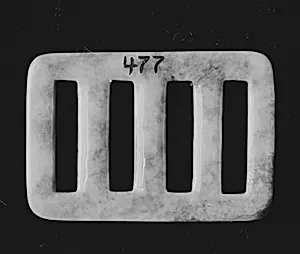
Girdle buckle
Unknown Artist
Medium
Jadeite, lettuce-green mottled with white with faint grayish tint
Dimensions
H. 2 1/4 in. (5.7 cm); W. 1 9/16 in. (3.9 cm); D. 3/16 in. (0.5 cm)
Classification
Jade
Culture & Period
China · Qing dynasty (1644–1911), Yongzheng period (1723–35)
Department
Asian Art
Museum
Metropolitan Museum of Art, New York, NY
Credit
Gift of Heber R. Bishop, 1902
Accession Number
02.18.477
Rights
Public Domain
Art Historical Context
This exquisite girdle buckle, crafted from lettuce-green jadeite mottled with white and a grayish tint, hails from China's Qing dynasty during the Yongzheng period (3–35). Measuring just 2¼ inches high, 1⅜ inches wide, and a slender ⅜ inch deep, it exemplifies the refined elegance of imperial jade carving. Once part of a belt or sash—known as a "girdle" in traditional attire—this small accessory blended functionality with opulent decoration, often adorning the robes of scholars, officials, or nobility. Jadeite, a prized variety of jade rarer and more vivid than nephrite, held profound cultural significance in China, symbolizing purity, immortality, and moral virtue. During the Yongzheng reign, renowned for its artistic sophistication and meticulous craftsmanship, imperial workshops elevated jade objects to pinnacles of technical mastery. Artisans likely employed delicate incising and polishing techniques to accentuate the stone's natural veining, creating a luminous, almost ethereal quality that reflected the era's aesthetic restraint and imperial prestige. Today, this buckle graces the Metropolitan Museum of Art's Asian Art collection, a gift from Heber R. Bishop in 1902. It offers a window into Qing elite life, where even everyday fasteners became treasures of artistry and status.