
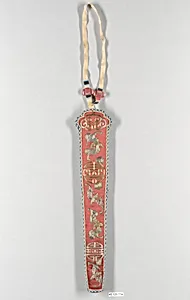
Girdle Set with Bats and the Character for Longevity (Shou)
Unknown Artist
19th century
Medium
Silk, metallic thread, glass(?)
Dimensions
Overall (a): 12 x 3 in. (30.5 x 7.6 cm) Overall (b): 5 x 3 in. (12.7 x 7.6 cm) Overall (c): 5 x 3 in. (12.7 x 7.6 cm) Overall (d): 5 x 5 in. (12.7 x 12.7 cm) Overall (e): 3 1/2 x 3 in. (8.9 x 7.6 cm) Overall (f): 3 1/2 x 3 in. (8.9 x 7.6 cm) Overall (g): 2 x 1 1/2 in. (5.1 x 3.8 cm)
Classification
Textiles-Embroidered
Culture & Period
China · Qing dynasty (1644–1911)
Department
Asian Art
Museum
Metropolitan Museum of Art, New York, NY
Credit
Gift of Florance Waterbury, 1945
Accession Number
45.125.11a–g
Rights
Public Domain
Tags
Art Historical Context
This exquisite girdle set, crafted in 19th-century China during the Qing dynasty (1644–1911), showcases the era's masterful embroidery traditions. Comprising seven small silk panels adorned with metallic threads and possibly glass elements, the set measures from 2 x 1½ inches to 12 x 3 inches. Worn as ornamental accessories on belts or sashes, these pieces reflect the refined artistry of personal adornment in late imperial China, where textiles blended functionality with symbolic elegance. Central to the design are playful bats fluttering alongside the Chinese character *shou* (壽), emblematic of longevity and eternal life. In Chinese culture, bats symbolize good fortune (*fu*), as the word for bat homophonically evokes "happiness" or "prosperity." Paired with *shou*, these motifs embodied wishes for a long, blessed existence—auspicious themes popular in Qing decorative arts for clothing and gifts. The intricate stitching, likely using techniques like satin or Peking stitch, highlights the skill of anonymous embroiderers who elevated everyday silk into talismans of well-being. A gift to the Metropolitan Museum of Art in 1945, this set offers a glimpse into Qing opulence, where even intimate accessories carried profound cultural weight. Visitors will appreciate its delicate sparkle and timeless optimism.