
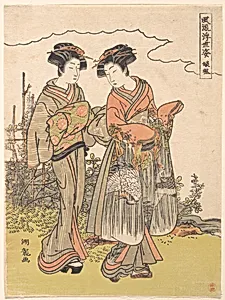
Girl Accompanied by an Elder Attendant Walking by a Stream
ca. 1770
Medium
Woodblock print; ink and color on paper
Dimensions
10 1/2 x 7 1/4 in. (26.7 x 18.4 cm)
Classification
Prints
Culture & Period
Japan · Edo period (1615–1868)
Department
Asian Art
Museum
Metropolitan Museum of Art, New York, NY
Credit
The Howard Mansfield Collection, Purchase, Rogers Fund, 1936
Accession Number
JP2626
Rights
Public Domain
Tags
Art Historical Context
**Girl Accompanied by an Elderendant Walking by a Stream *Isoda Koryūsai, ca. 1770* Woodblock print; ink and color on paper 10 1/2 x 7 1/4 in. (26.7 x 184 cm). The Metropolitan Museum of Art, York. This charming woodblock print by Isoda Koryūsai captures a serene moment in Edo-period Japan: a young girl strolling by a stream, guided by an elder attendant, surrounded by lush plants. Created around 1770 during the vibrant Edo period (1615–1868), it exemplifies *ukiyo-e*—"pictures of the floating world"—a genre celebrating everyday beauty, urban life, and nature's fleeting pleasures. Koryūsai, a master of *bijin-ga* (images of beautiful women), infused his works with delicate elegance, blending graceful figures with natural motifs to evoke tranquility and harmony. The medium of color woodblock printing was revolutionary, allowing affordable mass production through intricate carving of multiple woodblocks for layered inks, producing vivid "brocade pictures" (*nishiki-e*). This technique democratized art, making it accessible beyond elites. Culturally, such prints reflected Japan's peaceful prosperity, idealizing youthful innocence and seasonal beauty amid bustling cities like Edo (modern Tokyo). Tags like "Girls" and "Plants" highlight themes of femininity and nature's renewal, offering visitors a window into 18th-century Japanese aesthetics and social graces. A gem from The Howard Mansfield Collection, it invites contemplation of life's gentle rhythms.
About the Artist
Isoda Koryūsai · 1735–1790
Japanese, 1735–ca. 1790