
Girl in the Dunes
mid-19th–early 20th century
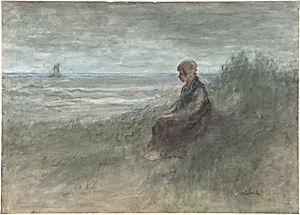
Medium
Watercolor and touches of black chalk on paper
Dimensions
Overall: 12 5/8 x 17 3/4 in. (32.1 x 45.1 cm)
Classification
Drawings
Department
Drawings and Prints
Museum
Metropolitan Museum of Art, New York, NY
Credit
Mr. and Mrs. Isaac D. Fletcher Collection, Bequest of Isaac D. Fletcher, 1917
Accession Number
17.120.234
Rights
Public Domain
Tags
Art Historical Context
**Girl in the Dunes by Jozef Israë captures the serene beauty of the Dutch coastline in a delicate watercolor heightened with touches of black chalk on paper Created during the mid-19th to early 20th century, intimate drawing (12⅝ × 17¾ in.) depicts a young girl amidst expansive dunes, with hints of boats evoking the everyday life of coastal communities. Israëls, a leading figure of the Hague School—a Dutch movement inspired by the French Barbizon painters—excelled in portraying humble fishermen and rural scenes with poignant realism and emotional depth. The watercolor medium suits Israëls's masterful handling of light and atmosphere, allowing soft, luminous effects that mimic the shifting dunes and sea breezes of the Netherlands. Black chalk accents add subtle definition, enhancing the work's lyrical quality. As part of the Metropolitan Museum of Art's Drawings and Prints collection, gifted through the Isaac D. Fletcher bequest in 1917, it exemplifies the artist's shift from genre scenes to more contemplative landscapes late in his career. This piece invites visitors to ponder the quiet resilience of ordinary lives against nature's vastness, a hallmark of Hague School humanism that bridged Romanticism and Realism.
About the Artist
Jozef Israëls · 1824–1911
Israëls was born in Groningen to poor Jewish parents. He trained as an artist in Groningen and Amsterdam, and between 1845 and 1855, he expanded his training by travelling to Paris, Dusseldorf, and the artist's colony at Oosterbeek. However, the most influential locations he visited were the Dutch seaside towns of Zandvoort and Katwijk, were he adopted genre painting as a means of documenting the ...