
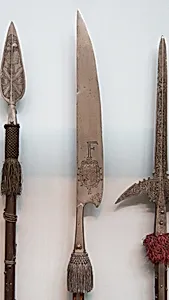
Glaive of the Bodyguard of Archduke Ferdinand of Austria, later Emperor Ferdinand II (1578–1637)
Unknown Artist
1590–1617
Medium
Steel, wood, textile
Dimensions
L. 29 17/32 in. (75.01 cm); W. 3 11/32 in. (8.51 cm)
Classification
Shafted Weapons
Culture
German
Department
Arms and Armor
Museum
Metropolitan Museum of Art, New York, NY
Credit
Gift of William H. Riggs, 1913
Accession Number
14.25.268
Rights
Public Domain
Art Historical Context
Step into the world of Renaissance-era defense with the *Glaive of the Bodyguard of Archduke Ferdinand of Austria, later Emperor Ferdinand II (1578–1637)*. This formidable shafted weapon, crafted in Germany between 1590 and 1617, served as elite protection for the young archduke during a time of political intrigue in the Holy Roman Empire. Glaives like this were prized by bodyguards for their reach and slashing power, combining a long wooden shaft with a broad steel blade ideal for close-quarters combat or ceremonial display. Forged from steel, with wood and textile elements, the glaive measures 29 17/32 inches (75.01 cm) in length and 3 11/32 inches (8.51 cm) wide, showcasing the meticulous craftsmanship of German armsmakers. Its robust construction reflects the era's advancements in metallurgy, balancing lethality with durability for imperial guards facing threats amid rising religious and dynastic tensions. Today, this artifact graces the Metropolitan Museum of Art's Arms and Armor Department, a 1913 gift from William H. Riggs. It offers a tangible link to Ferdinand II's early life, before his reign sparked the Thirty Years' War, reminding us how weapons embodied power, loyalty, and survival in Europe's turbulent courts.