
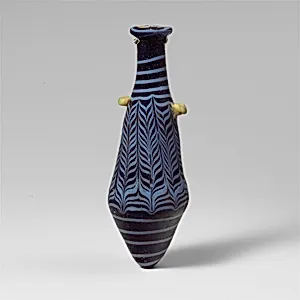
Glass alabastron (perfume bottle)
Unknown Artist
2nd–mid 1st Century BCE
Medium
Glass
Dimensions
4 7/8 × 1 11/16 in. (12.5 × 4.2 cm) Diam. of rim: 7/8 in. (2.3 cm)
Classification
Glass
Culture & Period
Greek, Eastern Mediterranean · Hellenistic
Department
Greek and Roman Art
Museum
Metropolitan Museum of Art, New York, NY
Credit
Edward C. Moore Collection, Bequest of Edward C. Moore, 1891
Accession Number
91.1.1408
Rights
Public Domain
Art Historical Context
This delicate glass alabastron, slender perfume bottle from the Hellenistic period (nd–mid 1st century BCE), hails from the Greek culture of the Eastern Mediterranean. just under 5 inches tall with a narrow rim, it exemplifies the everyday elegance of ancient luxury goods. Alabastra like this were designed to hold scented oils or perfumes, essential for personal grooming, religious rituals, and social displays in a cosmopolitan world shaped by Alexander the Great's conquests. Crafted during a time when glassmaking flourished in the region, this vessel highlights advanced Hellenistic techniques. Artisans likely used core-forming methods—winding molten glass around a removable core—to create its graceful, elongated form. Translucent and lightweight, such bottles were prized for their practicality and beauty, bridging utility and art in a period of cultural fusion between Greek, Persian, and Egyptian influences. Now part of the Metropolitan Museum of Art's Greek and Roman Art collection, thanks to the Edward C. Moore bequest of 1891, this alabastron offers a tangible link to Hellenistic daily life. Imagine an ancient visitor dabbing fragrant oil from its neck— a small object whispering stories of beauty and devotion across millennia.