
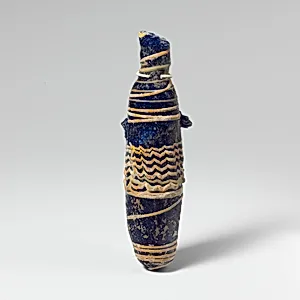
Glass alabastron (perfume bottle)
Unknown Artist
3rd–2nd century BCE
Medium
Glass
Dimensions
H.: 5 3/16 in. (13.2 cm) Diam.: 1 5/16 in. (3.4 cm) Other: 1 1/2 in. (3.9 cm)
Classification
Glass
Culture & Period
Greek, Eastern Mediterranean · Hellenistic
Department
Greek and Roman Art
Museum
Metropolitan Museum of Art, New York, NY
Credit
Gift of J. Pierpont Morgan, 1917
Accession Number
17.194.592
Rights
Public Domain
Art Historical Context
This delicate glass alabastron, a slender perfume bottle from the Hellenistic period (3rd–2nd century BCE), hails from the Greek Eastern Mediterranean—likely a bustling hub like Rhodes or Alexandria, where innovative glassmaking flourished after Alexander the Great's conquests. Standing just over 5 inches tall with a narrow diameter of about 1.3 inches, its elegant, elongated form was designed for storing precious scented oils, allowing precise pouring through a pinched neck and tiny mouth sealed with wax or a stopper. Crafted using the core-formed technique—a hallmark of early Hellenistic glasswork—a removable clay core was coated with molten glass threads in vibrant colors, often blues and greens, then smoothed and decorated with trailing motifs. This labor-intensive method produced luxury items affordable only to the elite, blending Eastern technical prowess with Greek aesthetic refinement. Alabastra like this were everyday treasures, used in grooming rituals, symposia, and religious offerings, symbolizing the period's cosmopolitan fusion of cultures and heightened realism. Today, this exquisite piece graces the Metropolitan Museum of Art's Greek and Roman Art department, a gift from J. Pierpont Morgan in 1917, offering a glimpse into the sensory world of antiquity.