
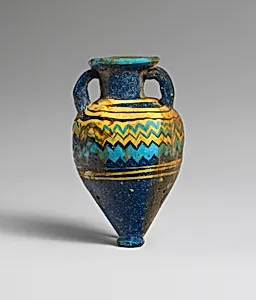
Glass amphoriskos (perfume bottle)
Unknown Artist
late 6th–5th century BCE
Medium
Glass
Dimensions
H.: 2 11/16 in. (6.8 cm)
Classification
Glass
Culture & Period
Greek, Eastern Mediterranean · Classical
Department
Greek and Roman Art
Museum
Metropolitan Museum of Art, New York, NY
Credit
Gift of Henry G. Marquand, 1881
Accession Number
81.10.329
Rights
Public Domain
Art Historical Context
This delicate glass amphoriskos a small perfume bottle shaped like a miniature amphora, hails from the Eastern Mediterranean during the late 6th to 5th century BCE, heart of Greece's Classical period. Standing just 2 11/16 inches tall, it exemplifies the exquisite craftsmanship of ancient glassmakers, who formed such vessels using innovative core-forming techniques—wrapping molten glass trails around a removable clay core. These tiny bottles were prized luxury items, holding scented oils or perfumes essential for daily grooming, religious rituals, and even funerary offerings. In Greek culture, amphoriskoi like this bridged the practical and the beautiful, reflecting the era's appreciation for refined elegance amid expanding trade networks across the Mediterranean. Glass, though fragile, was a status symbol rarer than pottery, often featuring vibrant colors and trailed decorations (though specifics here are subtle). Its survival speaks to the durability of these artifacts, now housed in the Metropolitan Museum of Art's Greek and Roman Art Department, thanks to a generous 1881 gift from Henry G. Marquand. Imagine an ancient visitor dabbing perfume from this gem— a whisper of opulence from antiquity, inviting us to ponder the sensory world of Classical Greece.