
Glass amphoriskos (perfume flask)
Unknown Artist
1st century CE
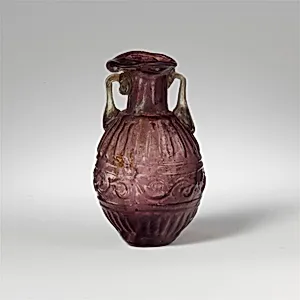
Medium
Glass
Dimensions
Height: 2 11/16 in. (6.7 cm) Diameter: 1 7/16 in. (3.7 cm) Width (with handles): 15/16 in. (2.4 × 0.4 cm)
Classification
Glass
Culture & Period
Roman, Syrian · Early Imperial
Department
Greek and Roman Art
Museum
Metropolitan Museum of Art, New York, NY
Credit
Edward C. Moore Collection, Bequest of Edward C. Moore, 1891
Accession Number
91.1.1250
Rights
Public Domain
Art Historical Context
This exquisite glass amphoriskos, a petite perfume flask from 1st-century CE Roman Syria, captures the elegance of everyday luxury in the Early Imperial. Standing just 2 11/16 inches tall with slender handles, its amphora-like form mimics larger storage vessels but on a intimate scale, perfect for carrying scented oils, cosmetics, or medicines. Crafted during the height of the Roman Empire, it reflects Syria's pivotal role as a glassmaking hub, where innovative techniques allowed for such delicate, translucent objects. The flask's creation highlights the era's glassblowing revolution, likely originating in Syrian workshops and traded across the Mediterranean. Its iridescent surface and precise proportions showcase masterful control of molten glass, transforming a functional item into a work of subtle beauty. In Roman culture, perfumes were essential for grooming, social rituals, and even funerary practices, underscoring personal vanity and trade networks that connected East and West. Housed in the Metropolitan Museum of Art's Greek and Roman Art department as part of the Edward C. Moore Collection (bequest of 1891), this amphoriskos invites us to imagine a Roman patron delicately applying fragrance, bridging ancient craftsmanship with our modern appreciation for refined simplicity.