
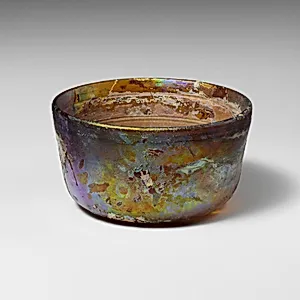
Glass bowl
Unknown Artist
late 1st century BCE–early 1st century CE
Medium
Glass
Dimensions
Height: 2 3/8 in. (6 cm) Diameter: 4 1/4 in. (10.8 cm)
Classification
Glass
Culture & Period
Roman · Early Imperial
Department
Greek and Roman Art
Museum
Metropolitan Museum of Art, New York, NY
Credit
The Cesnola Collection, Purchased by subscription, 1874–76
Accession Number
74.51.261
Rights
Public Domain
Art Historical Context
This delicate glass bowl, crafted by an unknown Roman artisan during the late 1st century BCE early 1st century CE, exemplifies Early Imperial period's remarkable advancements in glassmaking. Measuring just 2 3/8 inches high and 4 1/4 inches in diameter, would have fit comfortably in the hand, likely serving as tableware, a cosmetic container, or a vessel for precious oils in wealthy household. Roman glass production reached new heights around this time, from core-formed and mold-blown techniques to the revolutionary free-blowing method pioneered in the eastern Mediterranean. Transparent and lightweight, such bowls were prized for their clarity and luster, symbolizing the Empire's technological prowess and trade networks spanning from Syria to Italy. This piece, part of the Cesnola Collection at The Metropolitan Museum of Art, highlights Cyprus's role as a hub for Roman craftsmanship. Though simple in form, the bowl reflects everyday luxury in ancient Rome, where glass democratized fine vessels once reserved for elite metals. Visitors can appreciate how such artifacts bridged utility and artistry, offering a tangible glimpse into the domestic life of the Augustan era.