
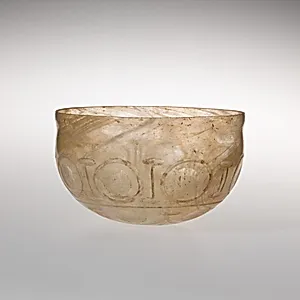
Glass bowl
Unknown Artist
3rd century CE
Medium
Glass
Dimensions
H.: 2 1/4 in. (5.7 cm) Diam.: 3 3/4 in. (9.5 cm)
Classification
Glass
Culture & Period
Roman · Mid Imperial
Department
Greek and Roman Art
Museum
Metropolitan Museum of Art, New York, NY
Credit
Edward C. Moore Collection, Bequest of Edward C. Moore, 1891
Accession Number
91.1.1330
Rights
Public Domain
Art Historical Context
This delicate glass bowl, crafted by an unknown Roman artisan in the 3rd century CE during the Mid Imperial period, the everyday elegance of ancient Roman tableware. Standing just 2¼ inches (5.7 cm) tall with a diameter of 3 inches (9.5 cm), its modest size suggests it was designed for personal use—perhaps holding olives, spices, or cosmetics in a wealthy household. Housed in the Metropolitan Museum of Art's Greek Roman Art Department, it the collection through the bequest of Edward C. in 1891. Roman glassmaking reached new heights by this era, with techniques like free-blowing enabling the mass production of thin-walled vessels that were both functional and beautiful. Previously a luxury reserved for the elite, glass became affordable for middle-class homes, reflecting the empire's technological prowess and cultural emphasis on refined domestic life. This bowl's survival offers a tangible glimpse into Mid Imperial society amid the empire's vast trade networks, from the Levant to Gaul. Though undecorated, its translucent quality and precise form highlight the artisan's skill, underscoring glass's role as a democratic medium in Roman art—bridging utility and subtle artistry. A quiet treasure, it invites us to ponder the hands that once held it.