
Glass Bowl
Unknown Artist
late 10th–early 11th century
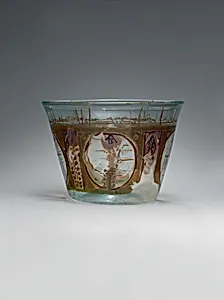
Medium
Glass, bluish; blown, stained
Dimensions
H. 4 3/16 in. (10.7 cm) Max. Diam. 6 in. (15.3 cm)
Classification
Glass
Department
Islamic Art
Museum
Metropolitan Museum of Art, New York, NY
Credit
Purchase, Rogers Fund and Gifts of Richard S. Perkins, Mr. and Mrs. Charles Wrightsman, Mr. and Mrs. Louis E. Seley, Walter D. Binger, Margaret Mushekian, Mrs. Mildred T. Keally, Hess Foundation, Mehdi Mahboubian and Mr. and Mrs. Bruce J. Westcott, 1974
Accession Number
1974.74
Rights
Public Domain
Art Historical Context
This delicate bluish glass bowl, crafted in the late 10th to early 11th century, the exquisite glassmaking traditions of the Islamic world during the medieval period. Produced anonymously by a skilled artisan, it hails from a time when Islamic artisans, particularly in regions like Egypt and Syria under Fatimid influence, revolutionized glass production. Standing just over 4 inches tall with a 6-inch diameter, its modest size belies its refined elegance, likely used for serving fruits, sweets, or beverages in affluent households. The bowl's medium—blown and stained glass—highlights innovative techniques that set Islamic glass apart. Free-blowing allowed for thin, lightweight forms with graceful curves, while staining with metallic compounds created the subtle bluish hue, a hallmark of luxury wares. This combination produced translucent vessels that caught and refracted light beautifully, blending utility with artistry. Such objects were prized for export across the Mediterranean and beyond, symbolizing cultural sophistication. Acquired by the Metropolitan Museum of Art in 1974 through generous gifts and the Rogers Fund, this bowl offers visitors a tangible link to Islamic ingenuity, where everyday items became vessels of beauty and technical mastery.