
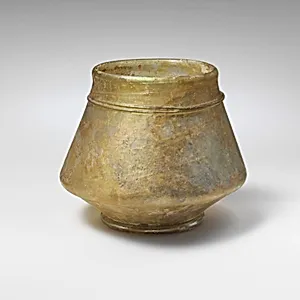
Glass cup
Unknown Artist
2nd–3rd century CE
Medium
Glass
Dimensions
2 3/4 in. (7 cm) Diameter: 3 5/16 x 2 1/4 in. (8.4 x 5.7 cm)
Classification
Glass
Culture & Period
Roman · Mid Imperial
Department
Greek and Roman Art
Museum
Metropolitan Museum of Art, New York, NY
Credit
The Cesnola Collection, Purchased by subscription, 1874–76
Accession Number
74.51.242
Rights
Public Domain
Art Historical Context
This delicate glass cup, crafted by an unknown Roman artisan in the 2nd–3rd century CE during the Mid Imperial period, the everyday elegance of Roman material culture. Standing just 2¾ inches (7 cm) tall with a diameter of 3⅜ x 2¼ inches (8.4 x 5.7 cm), its petite scale suggests it was designed for personal use, perhaps for sipping wine or water at a modest meal. Acquired as part of The Cesnola Collection now housed in the Metropolitan Museum of Art's and Roman Art Department, it reflects the ubiquity of glassware in Roman households across the empire. Roman glassmaking reached new heights of sophistication by this era, with techniques like free-blowing enabling the production of thin, transparent vessels that mimicked luxury materials such as rock crystal at a fraction of the cost. These cups were not rare treasures but practical objects, mass-produced in workshops from Italy to the eastern provinces, highlighting Rome's industrial prowess and cultural emphasis on refined domestic life. Though undecorated, its smooth form and clarity speak to skilled craftsmanship, preserving a glimpse of daily rituals in an expansive empire. Today, such artifacts remind us how Romans democratized beauty—turning sand, soda, and lime into enduring symbols of their world. A quiet marvel in the Met's vast collection!