
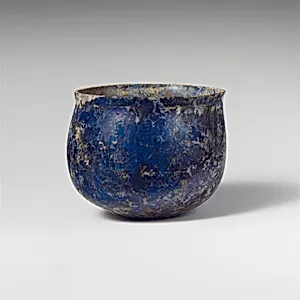
Glass cup
Unknown Artist
1st century CE
Medium
Glass
Dimensions
2 1/2 in. (6.4 cm) Diameter: 3 1/4 × 3 1/16 in. (8.3 × 7.8 cm)
Classification
Glass
Culture & Period
Roman · Early Imperial
Department
Greek and Roman Art
Museum
Metropolitan Museum of Art, New York, NY
Credit
The Cesnola Collection, Purchased by subscription, 1874–76
Accession Number
74.51.5708
Rights
Public Domain
Art Historical Context
This delicate glass cup, crafted by an unknown Roman artisan in the 1st CE during the Early Imperial period, the everyday elegance of ancient Roman life. Standing just 2½ inches tall with a diameter of about 3¼ inches, its petite size suggests it was designed for personal use—perhaps for sipping wine or scented oils at a symposium or intimate gathering. Housed in the Metropolitan Museum of Art's Greek Roman Art Department, it the collection through the Cesnola Collection, acquired by public subscription in 1874–76 from excavations on Cyprus, a key Roman province. Roman glassmaking reached new heights in this era, with innovations like glassblowing—perfected around the late 1st century BCE—allowing for thinner, lighter vessels that were both functional and beautiful. Unlike heavier cast glass of earlier periods, pieces like this cup highlight the Empire's mass production techniques, making luxury accessible beyond the elite. Free from elaborate decoration, its simple form underscores the transparency and clarity prized by Romans, evoking the purity of their material world. For visitors, this unassuming cup offers a tactile window into imperial domesticity: imagine a citizen of Rome or Cyprus holding it, its cool surface catching the flicker of oil lamps. A testament to enduring craftsmanship, it reminds us how ancient ingenuity shaped our modern appreciation for glass.