
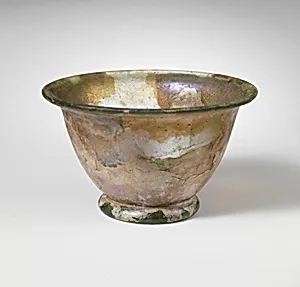
Glass cup
Unknown Artist
2nd–3rd century CE
Medium
Glass
Dimensions
H.: 1 15/16 in. (4.9 cm) Diam.: 3 1/4 x 1 9/16 in. (8.3 x 4 cm)
Classification
Glass
Culture & Period
Roman · Imperial
Department
Greek and Roman Art
Museum
Metropolitan Museum of Art, New York, NY
Credit
Gift of Henry G. Marquand, 1881
Accession Number
81.10.131
Rights
Public Domain
Art Historical Context
This delicate glass cup, crafted by an unknown Roman artisan in the 2nd–3rd century CE during the Imperial period, offers a glimpse into everyday elegance of the ancient world. Standing just under 2 inches tall with an oval rim measuring about 3¼ by 1½ inches, it was likely used for drinking wine, oils, or perfumes—common luxuries in Roman households. petite size suggests it was designed for personal use, portable and intimate, reflecting the empire's vast trade networks that distributed such wares from workshops in the eastern Mediterranean to Italy and beyond. Roman glassmaking reached new heights in this era, with techniques like free-blowing (perfected since the 1st century BCE) allowing for thin, lightweight vessels that captured light beautifully. Free from heavy decoration, this cup's simplicity highlights the material's inherent qualities: transparency, luster, and fragility. Glass was prized for its versatility, bridging utility and artistry, and symbolized refined taste among the elite and middle classes alike. Now housed in the Metropolitan Museum of Art's Greek and Roman Art Department—thanks to a gift from Henry G. Marquand in 1881—this modest treasure connects us to the ingenuity of Imperial Rome, where even a simple cup embodied technological prowess and cultural sophistication.