
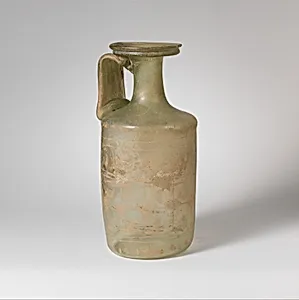
Glass cylindrical bottle
Unknown Artist
4th century CE
Medium
Glass
Dimensions
H.: 8 13/16 in. (22.4 cm)
Classification
Glass
Culture & Period
Roman · Late Imperial
Department
Greek and Roman Art
Museum
Metropolitan Museum of Art, New York, NY
Credit
Gift of J. Pierpont Morgan, 1917
Accession Number
17.194.327
Rights
Public Domain
Art Historical Context
This elegant glass cylindrical bottle, dating to the 4th century CE,ails from the Late Imperial Roman period and exemplifies the everyday artistry of the ancient world. Standing at 8 13/16 inches (22.4 cm) tall, its simple, functional form was likely used to store perfumes, oils, medicines—essentials in Roman households and for personal grooming. Crafted by an unknown artisan, it reflects the widespread accessibility of glassware by this era, when the Roman Empire spanned vast territories, blending utility with subtle refinement. Roman glassmaking reached remarkable sophistication centuries earlier with the invention of glassblowing around the 1st century BCE, a technique that allowed for quick production of shapes like this cylinder. By the Late Imperial phase (roughly 284–476 CE), under emperors like Constantine, glass was no longer a luxury but a staple, mass-produced in workshops across the Mediterranean. Translucent and lightweight, it offered an affordable alternative to pottery or metal, highlighting Rome's innovative material culture. Today, this bottle graces the Metropolitan Museum of Art's Greek and Roman Art department, a gift from J. Pierpont Morgan in 1917. It invites us to ponder the tactile world of late antiquity, where such unassuming objects carried the scents and secrets of daily life, bridging the gap between ancient utility and modern admiration.