
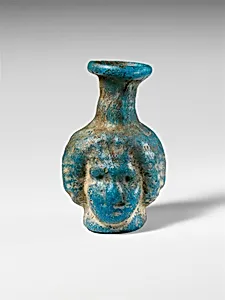
Glass double head flask
Unknown Artist
ca. 2nd century CE
Medium
Glass
Dimensions
H.: 2 1/4 in. (5.7 cm) Diam.: 1 3/8 x 1 in. (3.5 x 2.5 cm)
Classification
Glass
Culture & Period
Roman · Mid Imperial
Department
Greek and Roman Art
Museum
Metropolitan Museum of Art, New York, NY
Credit
Gift of J. Pierpont Morgan, 1917
Accession Number
17.194.240
Rights
Public Domain
Tags
Art Historical Context
This delicate glass double head flask, created in the Roman Empire around the 2nd century CE during the Mid Imperial period, exemplifies the sophisticated glassworking techniques of ancient artisans. Measuring just over two inches tall, the vessel was likely formed using molds to create its distinctive double-headed form, possibly evoking mythological figures or symbolic representations common in Roman decorative arts. Such small flasks often served practical purposes, holding perfumes, oils, or cosmetics, blending utility with artistic expression. Roman glassmaking flourished during this era, with craftsmen mastering both free-blowing and mold-casting methods to produce intricate shapes that were both affordable and elegant. The double-head design adds a layer of cultural intrigue, reflecting Roman interests in duality, portraiture, and protective imagery. As part of the Metropolitan Museum’s Greek and Roman Art collection, this piece highlights the everyday luxury items treasured in imperial households. Donated by J. Pierpont Morgan in 1917, the flask offers visitors a tangible connection to the artistic ingenuity of Roman society. Its compact scale and detailed molding demonstrate how even functional objects were elevated to works of art.