
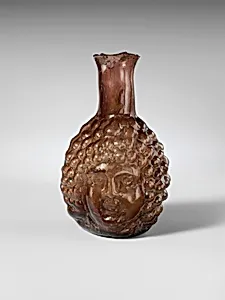
Glass double head-shaped flask
Unknown Artist
early 3rd century CE
Medium
Glass
Dimensions
3 3/16 x 1 3/4in. (8.1 x 4.5cm)
Classification
Glass
Culture & Period
Roman · Mid Imperial, Severan
Department
Greek and Roman Art
Museum
Metropolitan Museum of Art, New York, NY
Credit
The Cesnola Collection, Purchased by subscription, 1874–76
Accession Number
74.51.318
Rights
Public Domain
Tags
Art Historical Context
This exquisite glass double head-shaped flask, crafted by an unknown Roman artisan in the early 3 century CE, hails from the Mid Imperial Severan period—a dynamic era under emperors like Septimius Severus marked by cultural flourishing and artistic innovation across empire. Measuring just 3 3/16 x 1 3/4 inches (8.1 x 4.5 cm), its petite scale belies the technical prowess required to form such a delicate, symmetrical vessel featuring paired human heads, likely molded or blown into shape. Roman glassmaking reached new heights during this time, with the perfection of free-blowing techniques allowing for lightweight, translucent containers like this one. Often used to hold perfumes, oils, or cosmetics, these flasks were everyday luxuries that blurred the line between utility and art, reflecting the empire's advanced craftsmanship and appreciation for portrait-like realism. The double-head design adds a layer of intrigue, possibly evoking duality in Roman symbolism or simply showcasing the glassblower's skill in capturing expressive features. Now part of The Cesnola Collection at The Metropolitan Museum of Art's Greek and Roman Art department (purchased by subscription, 1874–76), this flask offers a tangible glimpse into daily Roman life, reminding us how ancient artisans transformed sand into shimmering storytelling objects.