
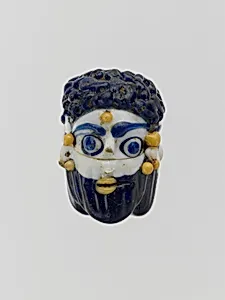
Glass face bead
Unknown Artist
mid-4th–3rd century BCE
Medium
Glass
Dimensions
Height: 3/4 × 3/8 in. (1.9 × 1 cm)
Classification
Glass
Culture & Period
Phoenician or Carthaginian · Late Classical
Department
Greek and Roman Art
Museum
Metropolitan Museum of Art, New York, NY
Credit
Gift of J. Pierpont Morgan, 1917
Accession Number
17.194.720
Rights
Public Domain
Tags
Art Historical Context
This delicate glass face bead, crafted in the mid-4th to 3rd century BCE,ails from Phoenician or Carthaginian culture the Late Classical period. just 3/4 × 3/8 inches (1.9 × 1 cm), it exemplifies the exquisite miniaturization achieved by ancient Mediterranean artisans. Phoenicians, master traders and innovators, were pioneers in glass production, developing techniques like core-forming or molding to create vibrant, portable objects such as beads for jewelry,ulets, or adornments. The bead's facial motif reflects the era's fascination with expressive human forms, possibly serving protective or decorative purposes in daily life or rituals. Its glassy medium—translucent and colorful—highlights advanced pyrotechnology, where silica was fused at high temperatures to yield durable, luminous results. Such tiny masterpieces traveled widely via Phoenician trade networks, linking the Levant to North Africa and beyond. Today, this treasure resides in the Metropolitan Museum of Art's Greek and Roman Art Department, a gift from J. Pierpont Morgan in 1917. It invites us to marvel at the ingenuity of anonymous creators whose work bridged cultures and endures as a window into ancient ingenuity.