
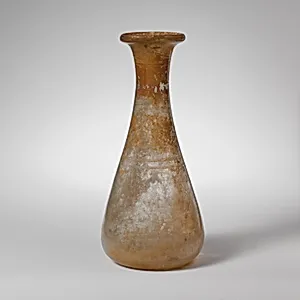
Glass flask
Unknown Artist
2nd–3rd century CE
Medium
Glass
Dimensions
6 7/16 in. (16.4 cm) Other: 2 15/16 in. (7.4 cm) Diam. of rim: 1 13/16 in. (4.6 cm)
Classification
Glass
Culture & Period
Roman · Mid Imperial
Department
Greek and Roman Art
Museum
Metropolitan Museum of Art, New York, NY
Credit
The Cesnola Collection, Purchased by subscription, 1874–76
Accession Number
74.51.24
Rights
Public Domain
Art Historical Context
This delicate glass flask, dating to the 2nd–3rd century CE during's Mid Imperial period, as a testament to the's mastery of glassmaking. Standing 6 7/16 inches (16.4 cm) tall with a narrow body widening to a 1 13/16-inch (4.6 cm) rim, it exemplifies the practical yet refined vessels produced in Roman workshops. Likely free-blown—a revolutionary technique perfected around the 1st century BCE flask's slender form and thin walls highlight the skill of anonymous artisans who transformed silica sand, soda, and lime into translucent luxury. In Roman culture, such flasks were everyday essentials, often holding perfumes, oils, or medicines, bridging utility and artistry. Their widespread production across the empire, from Italy to the eastern provinces like Cyprus (reflected in the Cesnola Collection), underscores glass's democratization as a material once reserved for elites. This piece, acquired for the Metropolitan Museum of Art through public subscription in 1874–76, offers visitors a glimpse into the vibrant domestic life of imperial Rome. Today, it captivates with its enduring clarity, reminding us how Roman innovation in glass not only fueled trade but also preserved scents and stories across millennia.