
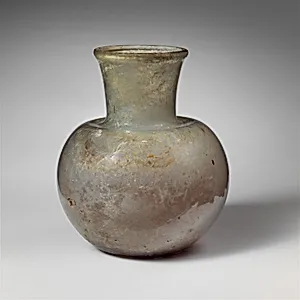
Glass flask
Unknown Artist
ca. 3rd century CE
Medium
Glass
Dimensions
Height: 3 3/4 in. (9.5 cm) Diam.: 3 1/4 x 1 3/4 in. (8.3 x 4.4 cm)
Classification
Glass
Culture & Period
Roman · Late Roman
Department
Greek and Roman Art
Museum
Metropolitan Museum of Art, New York, NY
Credit
The Cesnola Collection, Purchased by subscription, 1874–76
Accession Number
74.51.5753
Rights
Public Domain
Art Historical Context
This delicate glass flask, dating to around the 3rd century, exemplifies the artistry of Late Roman glassmaking. Standing just 3 3/4 inches tall with a bulbous body tapering to a narrow neck, it was likely used to hold perfumes, oils, or medicines—common luxuries in everyday Roman life. Crafted anonymously by a skilled artisan, its simple yet elegant form reflects the widespread accessibility of glass vessels during this era, thanks to the revolutionary technique of glassblowing introduced centuries earlier. Roman glass production reached new heights in the Late Empire, with workshops across the Mediterranean creating thousands of such items through free-blowing, where molten glass was shaped on a blowpipe. This flask's thin walls and subtle curves highlight the material's transparency and luster, qualities prized for both practical and aesthetic reasons. Part of The Cesnola Collection at The Metropolitan Museum of Art, it offers a glimpse into a thriving craft that symbolized Roman ingenuity amid the empire's challenges. Though small, this flask carries big cultural weight: glass was once as precious as gold in antiquity, evolving into an affordable staple that bridged utility and beauty in Roman households. Imagine a Roman matron dabbing scented oil from it— a touch of everyday elegance preserved for us today.