
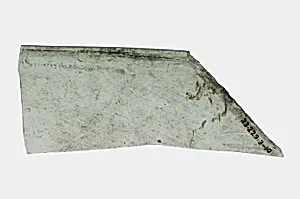
Glass Fragment
Unknown Artist
17th century
Medium
Colorless glass
Dimensions
Overall: 3 15/16 x 1 9/16 in. (10 x 4 cm)
Classification
Glass-Stained
Culture
French
Department
Medieval Art
Museum
Metropolitan Museum of Art, New York, NY
Credit
Gift of Dr. Bashford Dean, 1923
Accession Number
23.229.3-10
Rights
Public Domain
Art Historical Context
This delicate *Glass Fragment*, crafted in 17th-century France, offers a glimpse into the enduring tradition of stained glass artistry long after its medieval heyday. Measuring just 3 15/16 x 1 9/16 inches (10 x 4 cm), this small piece of colorless glass exemplifies the precision of French glassmakers during the Baroque era. Though classified as stained glass, its transparent quality suggests it may have been part of a larger window where pigments—applied via enameling or silver stain techniques—once created vibrant hues to filter light through church or chateau windows. By the 17th century, stained glass production had evolved from Gothic cathedrals to more secular or decorative uses, reflecting France's cultural shift under Louis XIV's grandeur. This fragment, housed in the Metropolitan Museum of Art's Medieval Art department, highlights the technical mastery of blowing and cutting thin glass sheets, a labor-intensive process that allowed light to dance with color. Its survival speaks to the fragility and rarity of such artifacts. A generous gift from Dr. Bashford Dean in 1923, this unknown artist's work invites us to ponder the luminous scenes it once illuminated—perhaps biblical tales or royal motifs—bridging centuries of craftsmanship for modern admirers.