
Glass Fragments
Unknown Artist
4th–early 5th century
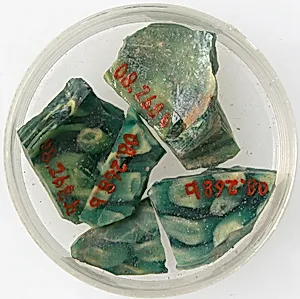
Medium
Glass (green)
Dimensions
Storage (petri dish diam.): 1 3/4 in. (4.4 cm)
Classification
Glass
Culture
Coptic
Department
Medieval Art
Museum
Metropolitan Museum of Art, New York, NY
Credit
Rogers Fund, 1908
Accession Number
08.268.54a-e
Rights
Public Domain
Art Historical Context
These delicate *Glass Fragments*, dating to the 4th–early 5th century, offer a glimpse into the vibrant world of Coptic Egypt, where early Christian communities blended ancient Egyptian traditions with emerging Byzantine influences. Produced during a transitional period after the Roman Empire's Christianization, Coptic artifacts like these reflect the daily life and craftsmanship of monastic and urban centers along the Nile. Though the artist remains unknown, the fragments' green hue—achieved through natural impurities or mineral additives—hints at the sophisticated glassmaking techniques honed in Egypt since Pharaonic times. Crafted from molded or blown glass, a medium prized for its translucency and durability, these tiny shards (stored in a 1 3/4-inch petri dish) likely originated from vessels, lamps, or decorative items used in homes, churches, or tombs. Green glass was especially popular in Coptic culture for its symbolic associations with renewal and the divine, evoking lush Nile landscapes. Acquired through the Rogers Fund in 1908, they now reside in the Metropolitan Museum of Art's Medieval Art department, underscoring glass's role as an accessible art form that democratized beauty in late antique society. Their survival speaks to the resilience of Coptic artistry amid cultural shifts, inviting us to ponder the hands that shaped them over 1,500 years ago.