
Glass Fragments from a Vessel
Unknown Artist
4th–early 5th century
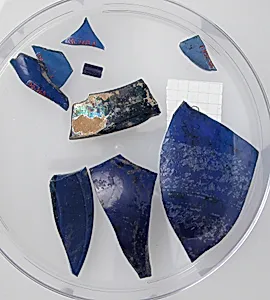
Medium
Glass (deep blue)
Dimensions
Storage (petri dish diam.): 5 9/16 in. (14.1 cm)
Classification
Glass-Vessels
Culture
Coptic
Department
Medieval Art
Museum
Metropolitan Museum of Art, New York, NY
Credit
Rogers Fund, 1908
Accession Number
08.268.26a-i
Rights
Public Domain
Art Historical Context
These delicate glass fragments, deep blue in hue, originate from a vessel crafted in Coptic Egypt during the 4th to early 5th century—a pivotal era when Christianity flourished amid the remnants of pharaonic and Greco-Roman traditions. Part of the Metropolitan Museum of Art's Medieval Art collection (acquired via the Rogers Fund in 1908), they exemplify the everyday artistry of Coptic culture, where skilled artisans produced functional objects blending utility with subtle beauty. The deep blue color, likely achieved through cobalt impurities, reflects advanced glassmaking techniques inherited from Ptolemaic and Roman Egypt. Vessels like this were wheel-cut or molded, often used for storage, lamps, or ritual purposes in monastic communities. Though fragmented today—preserved in a 5 9/16-inch petri dish—their iridescent translucency hints at the vibrant trade networks linking Egypt to the Byzantine world, underscoring glass as a democratized luxury. For visitors, these shards offer a tangible glimpse into Coptic life's quiet elegance, bridging ancient craftsmanship with early Christian devotion. Marvel at their enduring shimmer, a testament to artisans whose work outlasted empires.